How to build a website in Claude Code if you're not a programmer
You can build a website in Claude Code without programming skills: Claude writes the code itself, and you describe the pages in words, look at the result and send back the errors. You don't need the terminal, because there is an app with a Code tab. Check access first: Claude Code is not on the free plan, Pro costs from $17 a month, and Russia is not on the list of countries where Anthropic allows its services to be used.
Roman Kaufman, founder of Kaufman Lab · Data as of: October 2026
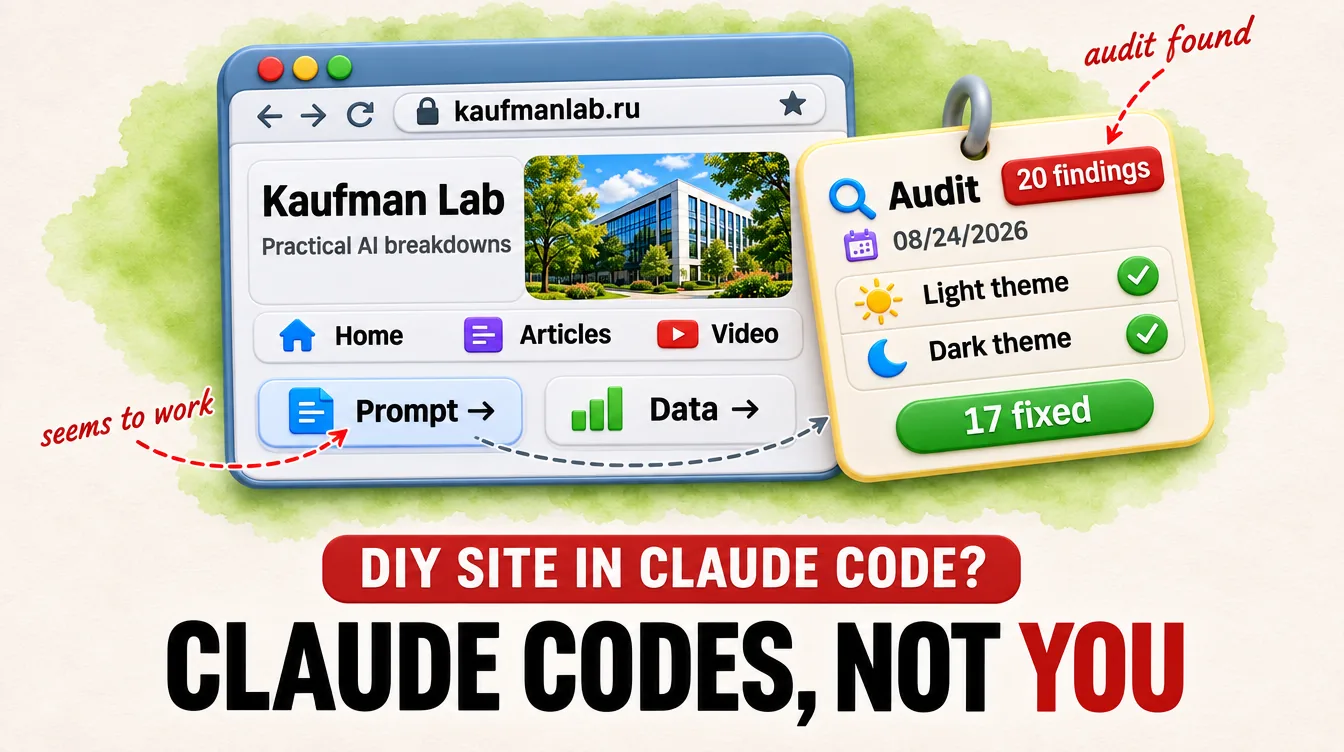
Before launching our site, we went through all of its pages, in the light and the dark theme, and wrote down 20 findings. Why are so many errors invisible until you go through all the pages one by one?
Claude Code writes the code, you set the task
Claude Code itself opens the site files in a folder on your computer, edits them and runs commands. You don't need to know markup. You give edits in words, like "bigger font" or "prices above the first screen".
Our site was built this way too, and the work on it is led by someone who is not a programmer. A person sets the task, Claude writes the markup, the styles and the build code, and a person again decides what to publish. According to our review of the change history at Kaufman Lab as of October 2026, 229 of the 280-plus changes to the site are marked as co-authored by Claude.
By our calculation at Kaufman Lab, based on the price lists of Tilda (a Russian website builder) and a Russian hosting provider as of October 2026, a business-card site on Tilda costs 6,000 rubles a year (about $74 at the Bank of Russia rate of 80.56 rubles per dollar on October 31, 2026). If you don't renew, it is taken offline, while your own site stays with you and costs about 4,000 rubles (about $50) a year plus a Pro subscription.
The site address in the .ru zone, the domain, costs 200 rubles (about $2.50) for the first year at that provider on a promotion and 399 rubles (about $5) after that. Server space for the files costs from 316 rubles (about $3.90) a month when paid for a year, and Tilda was counted the same way.
Send the error message back to Claude
If a page doesn't open or there is red text on the screen, you don't need to figure it out. Copy the whole error and give it to Claude.
In April 2025, Anthropic analyzed 500,000 conversations about code in its own services. In Claude Code, the loop where Claude does the task itself and a person checks it and sends back errors happened 1.7 times more often than in the regular chat. That's 35.8% of conversations versus 21.3%. The analysis doesn't say whether the users were programmers, so for you this share is only a guide.
After each edit, open the page again. The loop is closed when the error no longer appears. If an edit broke something that worked, don't fix on top of it, go back to the previous version. For this, keep the site folder in Git, which stores every saved version of the files.
A walkthrough finds errors, a list keeps them from coming back
An error that looks like a working feature stays invisible until you reach it. The page opens, and there is nothing to catch your eye.
Our site audit on August 24, 2026 produced 20 findings, and we fixed 17 of them the same day. The "Prompt" and "Data" links looked like they worked, with an arrow, but a click left the reader where they were. The page for wrong addresses promised twelve projects while the site had six. Someone had once typed that number by hand into an old layout.
One fix is not enough. As long as errors are caught only by eye, they come back. So we turned some of our findings into check rules, and a program runs them before publishing: if it finds an error, the site doesn't go to the server. You don't need a program. A list of what you found is enough: on the next walkthrough, you use it to look for the old errors on purpose.
Each step has a result on the screen
Claude will write the code, but only you will find a dummy link with an arrow, if you reach it with your list.
- Check access before installing. Russia is not on Anthropic's list of countries, and the rule is about where a person physically is. That's what the Supported Regions Policy says, in the version effective from November 12, 2026, and it is the company's rule, not a law. Done when your country is on the list and Pro is paid for.
- Install Claude Code. It's the Claude app with the Code tab or a command from the documentation. On Windows, you paste it into the PowerShell terminal, a window for commands. If you installed with the command, type `claude --version` in a new terminal window: if it shows a version number, the step is done.
- Sign in to your Claude account through the browser and ask for a finished page right away. It's easy to set the task using our breakdown of an AI agent prompt. The result on the screen here is simple: the page opened.
- Paste the full error text into Claude. The step is done when you have reopened the page after the edit and checked it.
- Before publishing, go through all the pages and check prices, dates and deadlines, names and the phone number. Done when every item is checked and what you found is written down.
If you're in a country on Anthropic's list, follow steps 1–5. If you're in Russia, Claude Code is not available to you under Anthropic's rules. Build a business-card site on a website builder with AI and go through it with step 5.
Frequently asked questions
Can I build a website in Claude Code for free?
No, the free Claude plan has no access to Claude Code. The cheapest plan with it, Pro, costs $17 a month when paid for a year ($200 up front) or $20 when paid monthly. The prices are from Anthropic's pricing page as of October 31, 2026.
How is Claude Code different from the chat?
The chat answers with text, while Claude Code works in the project folder itself: it reads and changes files and runs commands. You can open it in the terminal, a code editor, the app and the browser, and according to Anthropic's documentation, most of these need a subscription.
Isn't a site on Tilda simpler?
Both ways work for a business-card site. The difference is where the site lives. Tilda keeps it while you pay for the subscription. A site built in Claude Code is a set of files that stay with you, so you decide where it lives.