How to write articles with AI
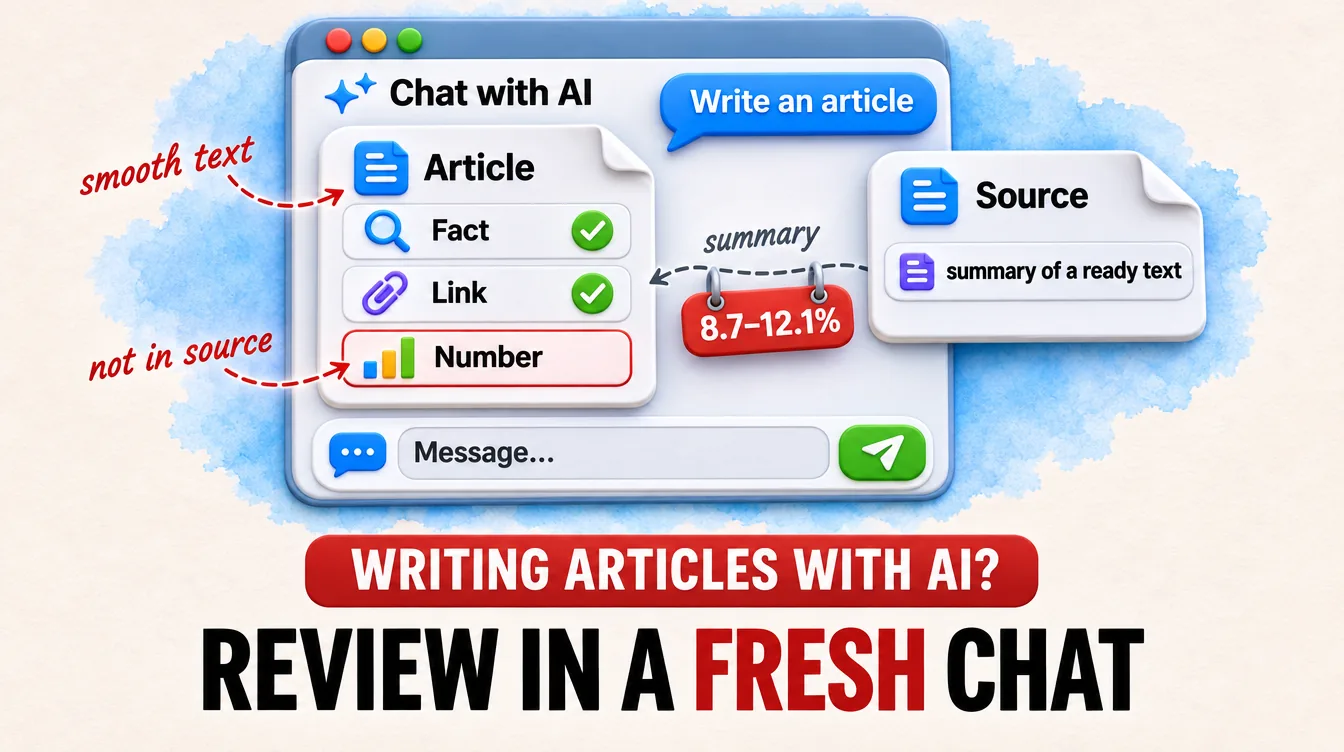
The reliable way to write articles with AI is to split the work into roles. You give the model your material and rules, it writes the text, and a new chat checks it. Search judges how useful a text is, no matter who wrote it. But a model makes things up even when it summarizes a ready text: flagship models do it in 8.7–12.1% of cases. So before you publish, open every link and check every number.
Roman Kaufman, founder of Kaufman Lab · Data as of: November 2026
Our AI-written post for Dzen (a Russian blogging platform) failed a uniqueness check. The service found too many matches with texts online, even though the post had no quotes at all. The same failure can hit an article for your website.
Search looks at how useful a text is, not at who wrote it
Google treats a flood of useless pages as a violation "no matter how it's created". This is in its spam policies, updated on October 7, 2026. Yandex, Russia's largest search engine, says in the help pages of Yandex Webmaster (Yandex's free tool for site owners) that low-quality sites include "sites with automatically generated content that is useless for the user".
In November 2025, people were ahead at the very top of search results. At that time, the Semrush service ran 42,000 blog pages from Google's top 10 through the GPTZero detector. Of the pages in 1st place, the detector judged 80% as written by a human and 9% as purely AI text (report from April 1, 2026). A study like this does not prove the cause. Detectors make mistakes, the study covers English-language pages, and we found no similar studies for Yandex.
The same report includes a survey of 224 specialists. 70% of SEO teams name speed as the main benefit of AI, and only 19% say it improves the quality of texts. In their experience, AI saves time but rarely adds quality.
AI writes smoothly but silently loses facts and requirements
Google's guidance on generative AI content, updated on October 5, 2026, says directly that "generative models don't retrieve facts, but predict a likely sequence of words". This leads to hallucinations: text that confidently states things that are not in the source. In a study by the company Vectara, where its own checker model catches the made-up parts, every model makes them, even when it summarizes a ready text. So smooth writing tells you nothing about accuracy.
The same goes for requirements. In our work on posts, in a long conversation the model "silently drops a requirement, while the result still looks done". This gave us our rule: "If a rule is not written down anywhere, the model will forget it by the third text." What keeps an article's quality is the process: your own material, written rules and a check in a clean chat.
If you run several channels, give each one its own rules file. Otherwise the texts will all sound the same.
Synonyms do not make a text yours, the reader's situation does
In our Dzen post, the matches came from a retelling that stayed too close to the legal wording of the original. Swapping words does not fix this. Google's spam policies give an example of a violation: pages mass-produced from someone else's text by swapping words for synonyms or by translating it, with doubtful value for people.
We made posts for Dzen at our content factory, and the check showed 93.99% uniqueness against a 97% threshold. We rewrote nine places where the retelling stayed close to the original, and explained each definition through a situation the reader might be in. The next check showed 100.00%.
We only measured uniqueness. We do not know if the post became more useful, and the 100% figure on its own does not prove quality. Your text will also become yours once it has your reader and your example in it.
Split material, writing and review, and keep the decision to publish for yourself
It was the check that caught the matches in the Dzen post, so checking gets its own step in the workflow.
- Write down your material and rules on one page before your first prompt. Who the text is for, facts with sources, what is not allowed. For example, "Reader: a beginner with their own website" and "No number without a link to its source".
- Ask for facts and text in separate prompts. First a list of facts with links, then "write based on these facts". If the topic needs expertise, you collect the facts and the model only writes. Otherwise let the model collect them, but in a separate prompt.
- Give the review to a new chat. Give it the rules, the text and the request "check point by point what is broken". A fresh chat sees what a long one no longer notices. Write down in advance what counts as done, as in our AI agent prompt. No more than three rounds of edits.
- Before publishing, check everything by hand. Open every link. Every number, date and name needs an open source. Google's guidance also asks for a manual accuracy check before publishing. Check the image against our guide to the rights to an AI-generated image.
If you write for your own website yourself, go through all four steps. If a team or a contractor writes the texts, keep step 4 for yourself.
Frequently asked questions
Can I write an article with AI for free?
The steps in this article do not depend on your plan. You can split material, writing and review in any chat, paid or free. Each service has its own limits on the number and length of prompts, and they are listed in its terms. We calculated the price of an article including the check in our breakdown of how much an AI-written article costs.
Which AI writes articles best?
None of the tested AI models writes without making things up. Only the error rate differs. In the open Vectara leaderboard (updated on October 22, 2026), models summarize the same articles. The best one makes errors in 1.8% of summaries, while the flagships GPT-6 Astra and Gemini 4 Argon make things up in 8.7–12.1%. Choosing a model does not replace fact-checking.
Can I hand the whole article over to AI?
You can hand over the text, but keep the decision to publish for yourself. AI can write and check an article by your rules, but a mistake that reaches readers costs more than the minutes you saved.