How to tell if a text was written by AI, and can you trust AI detectors?
You cannot know for sure that a text was written by AI. In a 2023 scientific test, no detector reached 80% accuracy, and they made mistakes both ways. If you wrote the text yourself and the tool says "AI", its score is not proof. A person makes the decision. First check the facts and links, and write your own texts in a document with version history.
Roman Kaufman, founder of Kaufman Lab · Data as of: October 2026
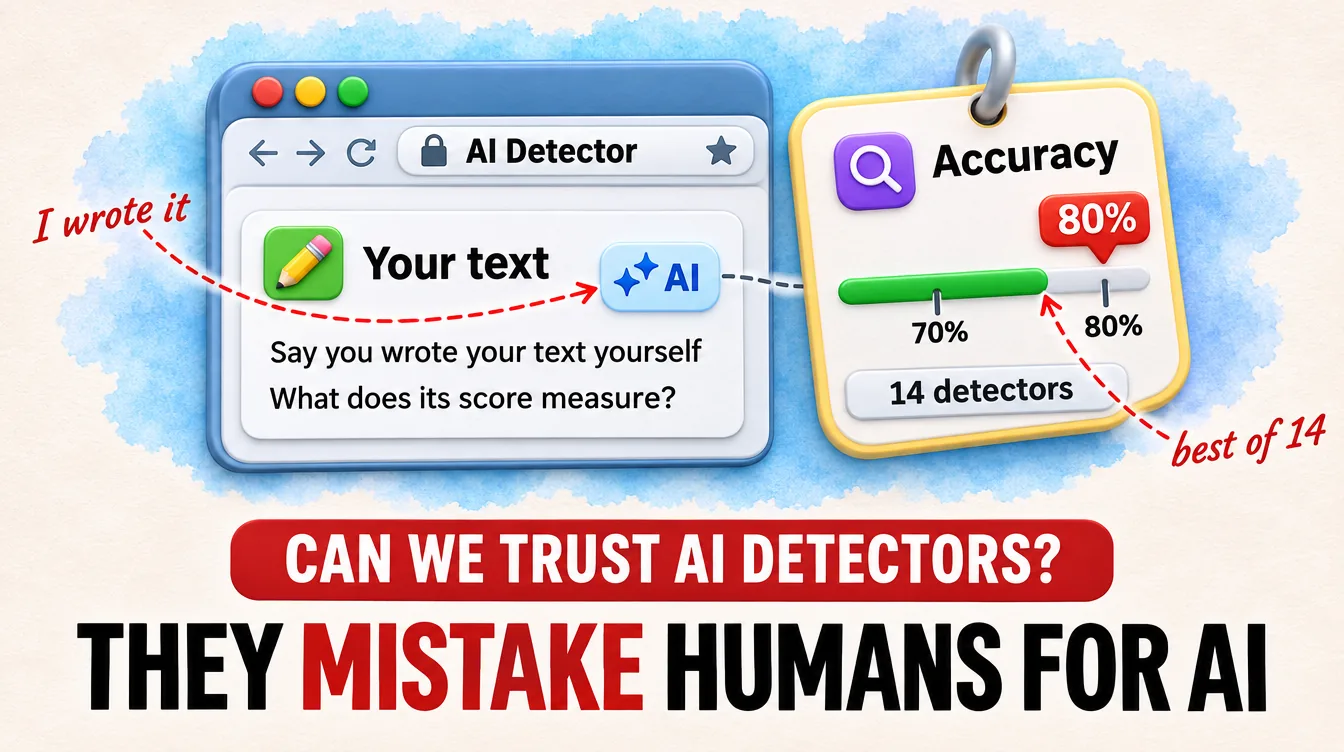
At our content factory, we accepted AI-written posts without an AI detector. People read them, a program searched them for clichés, and we measured their originality score. In the end, we did not trust those percentages either. Say you wrote your text yourself, and a detector marked it as "AI". What does its score actually measure?
None of 14 detectors reached 80% accuracy
The best of 14 detectors was wrong more often than once in every five answers, and only five gave more than 70% correct answers. That was the result of a test by Weber-Wulff and co-authors, published in the International Journal for Educational Integrity on December 25, 2023. In spring 2023, they ran 54 texts written by people and by ChatGPT. Six detectors gave false positives, which means they called a human a machine. AI texts that had been edited often slipped through.
We learned this lesson on originality scores. In our review of the Kaufman Lab log from July 14 to August 16, 2026, 60 of the first 73 checks showed exactly 100.00%, even though scores like 76.37% also came up on the first pass. When checks return the same number again and again, it is no longer a measurement. We did not run the posts through an AI detector, but the lesson applies to any service that gives a percentage: its number alone is not a measurement, and what you can trust is a check that can be repeated.
Yandex treats empty text as a violation, not AI
In October 2026, the help page of Yandex Webmaster (Yandex's tool for site owners) on low-value content flags text made by AI or from a template "without additional analysis and editing". Among the signs it lists are the same reasoning repeated, sentences written only to add length, and "presenting fictional or unverified facts as reliable".
A detector will not tell you whether a text is useful. In the test of 14 detectors, they gave a percentage or a phrase like "likely written by AI" with no evidence. If you trust it, you may rewrite your own text for nothing. If you skip the fact-check, you may publish something made up. A page that has already been marked low-value can be fixed step by step with our guide to low-demand pages in Yandex.
Detectors mistake simple words for AI
A detector often takes simple, predictable words as the work of AI, so its score says something about the language, not the author. Liang and co-authors from Stanford came to this conclusion in a paper on detector bias, published in the journal Patterns in July 2023. They tested seven popular detectors on 88 essays by American eighth graders and 91 essays for the TOEFL English exam by people for whom English is not their first language. The detectors almost never got the school essays wrong, but they called more than half of the TOEFL essays machine-written.
Then the researchers asked ChatGPT to simplify the words in the American students' essays, as if a non-native English speaker had written them. The average error rate of the detectors rose from 5.19% to 56.65%. When ChatGPT did the opposite and made the words in the TOEFL essays more complex, the error rate was 11.77%.
If you write in simple words, your text also risks getting an "AI" label. This was measured in 2023 in English. Our review has no similar test in Russian or with newer models. The score does not know how the work was done, but the edit history shows who changed what.
Keep your edit history and check the facts
A detector judges only by the words, so show how you did the work and give facts that can be checked.
- Write in Google Docs and save a named version before you hand it in. Click "Last edit" at the top right, choose a version, then open "More actions" and pick "Name this version" (Google's help page on version history).
- Check every number and quote against its source at the link, and remove it if you cannot find it there. Our breakdown of what an AI article costs shows what the hours spent on this kind of check cost.
- If someone accuses you based on a detector score, open "Last edit" on your own screen and show the versions to the person who decides. You can also give them edit access, since only people with edit access can see the version history. Even Turnitin, which sells a detector, says in its blog post of May 23, 2023 that its detector's score below 20% is less reliable, and it leaves the decision to teachers. If you are the one accepting someone else's text for your site, check it against the facts, as in step 2.
Frequently asked questions
Does humanizing AI text help?
Humanizing, which means editing AI text so it reads as if a person wrote it, fooled detectors in about half of cases. That is what the 2023 test of 14 detectors on edited texts showed. But made-up facts and empty paragraphs stay. Yandex treats them as signs of low-value text, and you have to fix them by hand.
Does Yandex have an AI detector?
As of October 31, 2026, we did not find an official AI detector from Yandex. The Yandex Webmaster help page on low-value content talks about how useful a text is. It says nothing about an AI percentage.
What gives AI away in a text, and what is AI slop?
AI slop is mass-produced empty text from AI models, and its signs are close to Yandex's list: repetition, sentences written only to add length, unverified facts. As of October 31, 2026, we did not find a measurement that would confirm any single sign of AI.